
When I started using computers, we had a Sinclair ZX Spectrum at home and a nano-reseau of Thomson MO5s at elementary school. I distinctly remember how unpleasant it was to type with them. These must have been the worst keyboards I ever used[1]. Ever since, I have paid close attention to the keyboards I use. Here is the list of my all-time favorites.
I discovered the IBM Model M in 1993 when I went over to the neighbor who owned an IBM PS/1 2168. I was immediately hooked to the feel of the keys and their clicky sound. It felt like using a typewriter and I loved it.
It took me many years to find one. I vividly remember that 2011 Craigslist ad for a dilapidated computer shop in a Toronto suburb. Inside I found piles of them, stacked six feet high. All of them had some kind of damage so I picked a few for $20 apiece and rebuilt one that looked pristine. I used it for nearly 10 years after that.
8BitDo has released a Model-M inspired modern mechanical keyboard. It looks gorgeous (1, 2, 3, 4, 5), sounds like a dream, and is overall an excellent keyboard that I have used a lot to play Diablo II: Resurrected.
It is only in 2025, when I was building my own IBM PS/1 2168, that I discovered the IBM Model M, SSK (Space Saving Keyboard) with 84 keys. Not having that cumbersome keypad eat up the space and pushing the mouse location further right is so convenient, it surpasses the 101/102-key version.


The NMB RT-9100W, ConcertMaster, is an icon. After id Software shipped Quake, they retired their NeXT-based stack in favor of Intergraph workstations running Windows NT. The RT-9100W came standard with the TDZ RealiZm purchased by id. This is the keyboard programmers used to write QuakeWorld, WinQuake, and QuakeGL.
John Carmack enjoyed working with this keyboard so much that he kept it for many years after Quake shipped. All subsequent id games, from Quake II, Quake III, to Doom 3 were written using this keyboard as assessed by the documentary G4 Documentary: The History of Doom and Making of Doom 3 (2003).

The membrane base makes the keys feel quite peculiar and not on par with a Model M. It is also a beast of a keyboard. But it has the advantage of packing the best sound system I have ever come across on a keyboard. The sound quality is surprisingly high, even when powered only by a 6-pin mini-DIN (PS/2) connector. The volume knob is ultra-convenient. And not having to add speakers on the desk is gold. It is a lovely keyboard that became the signature of my Quake build.

As I was getting older, I started to feel discomfort when I typed for extended periods of time. The problem was solved when I started using a keyboard that let my wrists and forearms be stable while working.
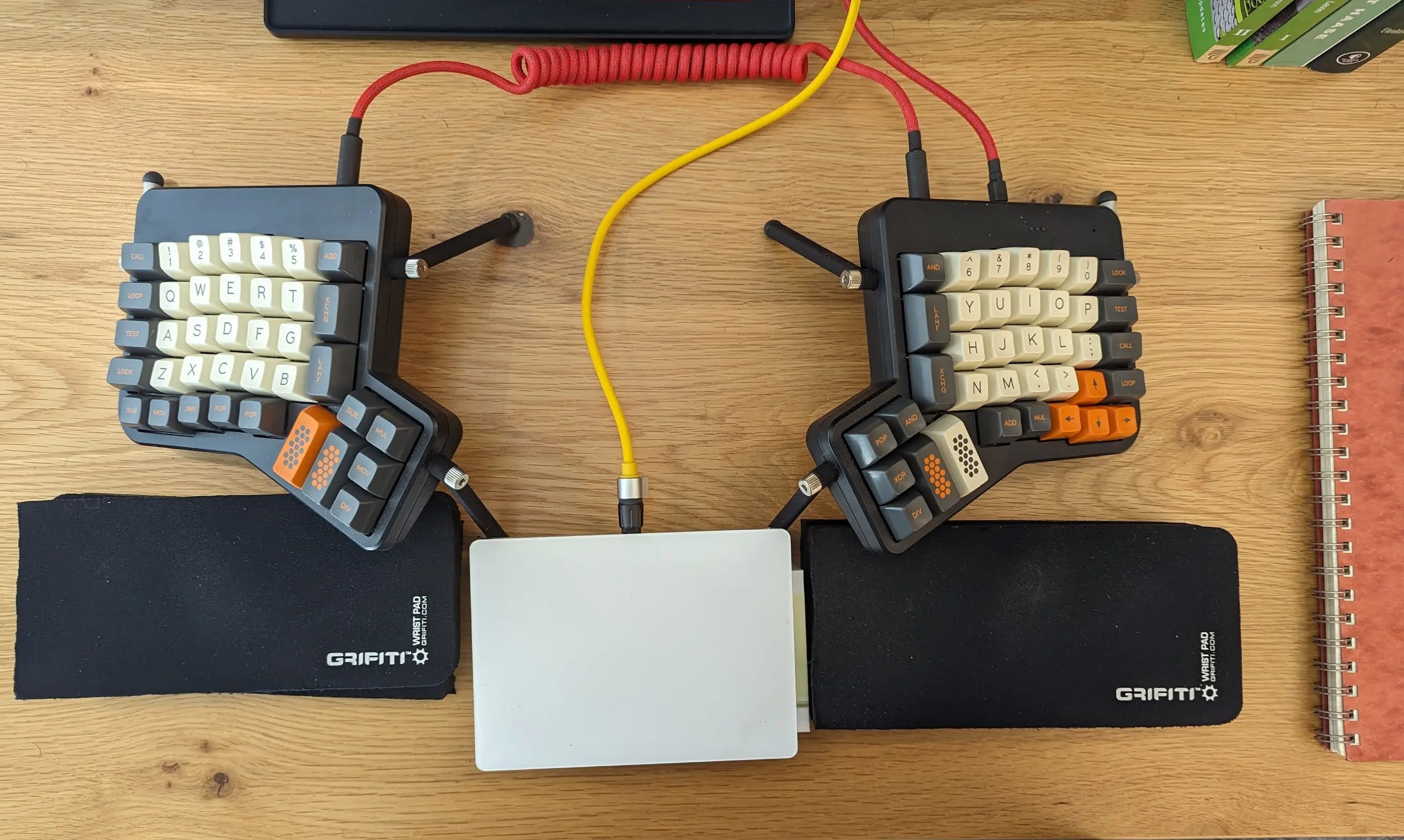
With its detached parts, the Ergodox EZ is able to adjust to any typist. I used that keyboard for 10 years. I liked it so much that I bought one for home and one for work.
I have raved and rambled about the Ergodox EZ. It solved my RSI problems. I thought it was going to be my last keyboard. There was just one problem.
It was impossible to tilt properly. I tried many ways to solve the issue, from the official Ergodox Tilt/Tent Kit to 3D-printing my own solutions. The result was always wobbly. Occasionally the legs would slip and the keyboard would crash onto the desk. I developed muscle memory to avoid pressing too hard on the keys, but that made me miss keystrokes.
Six months ago, I was invited to visit Ollama's HQ in Palo Alto. It turned out they had many keyboard connoisseurs there. One of them even worked with a gorgeous Model M. Another engineer's setup piqued my curiosity. They had something tilted nearly 50° that felt solid and stable. I immediately noticed that I was no longer afraid to press hard on the keys.

As soon as I got home, I ordered a ZSA Moonlander (Black / Kailh Box Brown / Printed Keys) with its Platform accessory. The Moonlander is my dream keyboard. It has everything the Ergodox EZ offers, and it remains ultra-stable while tilted on the Platform. I really hope this will be my last keyboard.
| ^ | [1] | Closely followed by my later machines, the Amstrad CPC 6128 keyboard, and the Atari 520 STE keyboard. |


